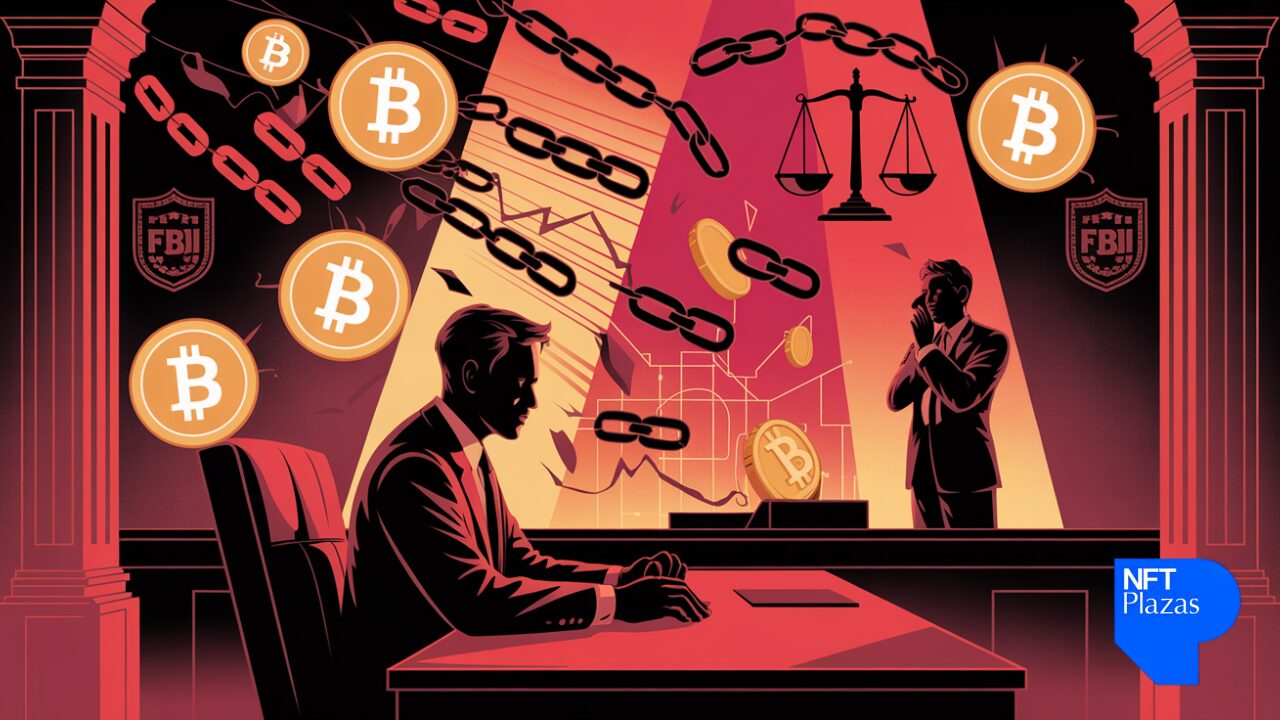
An Ohio investment manager who promised clients risk-free fortunes in Bitcoin derivatives while quietly routing their money to earlier investors was sentenced Monday to nine years in federal prison — the latest courtroom reckoning in what federal authorities describe as a surging wave of cryptocurrency fraud sweeping the United States.
Rathnakishore Giri, 31, of New Albany, Ohio, received a 108-month sentence along with three years of supervised release after pleading guilty to one count of wire fraud. The U.S. Department of Justice says Giri’s scheme defrauded investors of at least $10 million over several years — and that he kept defrauding them even after agreeing to plead guilty.
“Giri falsely promised investors that he would generate lucrative returns with no risk to their principal investment amount, which he guaranteed to return,” the DOJ said in a statement Monday. “In reality, Giri often used money provided by new investors to repay old investors — a hallmark of a Ponzi scheme.”

Ohio Man Sentenced to 9 Years for $10 Million Crypto Ponzi Scheme
A Polished Pitch Built on Lies
Giri marketed himself as a seasoned cryptocurrency trader with expertise in Bitcoin derivatives — a niche, technically complex corner of the market that helped lend his pitch an air of sophistication. Investors were told their principal was safe and that high returns were all but guaranteed. For many, that combination proved irresistible.
What they didn’t know was that Giri had a long and undisclosed track record of losing clients’ money. When investors grew suspicious and asked to cash out, he didn’t come clean. Instead, he fed them fabricated explanations for why withdrawals were delayed — stringing them along while the scheme continued to unravel beneath the surface.
The DOJ described this pattern as a deliberate and sustained effort to mislead. “Giri had a record of investment failures, including a long history of losing investors’ principal investments, and misled investors about reasons for delays when they sought to cash out their investments or otherwise obtain the return of their ‘guaranteed’ principal,” the agency said.

How Ponzi Schemes Work
Federal Net Closes In — Then He Kept Going
Regulatory authorities were the first to act. The Commodity Futures Trading Commission (CFTC) filed an enforcement action in August 2022 against Giri, his companies — SR Private Equity, LLC, and NBD Eidetic Capital, LLC — and his parents, accusing him of running an unlawful Bitcoin derivatives scheme dating back to at least 2019. The DOJ followed with a federal indictment in November 2022, charging him on five counts of wire fraud.
Giri pleaded guilty to one count of wire fraud in October 2024. But the story didn’t end there.
In a remarkable twist, federal prosecutors revealed ahead of Monday’s sentencing that Giri had continued soliciting money from new investors even after entering his guilty plea — behavior serious enough to warrant an amended plea agreement. “In advance of today’s sentencing, Giri admitted to this additional conduct pursuant to an amended plea agreement with the Department,” the DOJ statement read.
The brazenness of continuing to defraud investors while awaiting sentencing for fraud likely weighed on the judge’s decision, underscoring just how deeply embedded the behavior had become.
A Cautionary Tale in a $11 Billion Crisis
The Giri case is far from an isolated incident. It arrives amid a dramatic and troubling surge in crypto-related fraud across the United States.
In April, the FBI’s Internet Crime Complaint Center (IC3) reported that Americans lost a record $11.36 billion to cryptocurrency-related fraud in 2025 — a 22% increase over the previous year. The IC3 received more than 181,500 crypto-related complaints in 2025 alone. Authorities noted that elderly Americans are disproportionately targeted by these schemes, often because scammers exploit trust and unfamiliarity with digital assets.
Ponzi schemes like Giri’s follow a well-worn script: promise extraordinary returns, use new investor money to pay earlier ones, and paper over the cracks with excuses and delay tactics until the whole structure collapses. What changes is the packaging. In the 2020s, that packaging is crypto — an asset class that is simultaneously legitimate, volatile, complex, and poorly understood by many retail investors, making it fertile ground for fraud.

A Cautionary Tale in a $11 Billion Crisis
What Investors Should Know
Experts and regulators continue to urge investors to verify credentials before handing over money, to be deeply skeptical of any investment promising guaranteed returns with no risk, and to check whether a firm or individual is registered with the CFTC, SEC, or FINRA before investing.
“Guaranteed returns” and “no risk to principal” are phrases that should trigger immediate caution. No legitimate investment strategy can make those promises — particularly in a market as volatile as cryptocurrency.
For Giri’s victims, the nine-year sentence offers some measure of justice. But recovering the $10 million lost to his scheme will be another matter entirely — a reminder that in fraud cases, the damage done rarely stays neatly inside a courtroom.