
Table of Contents
The 2026 version of my favorite robot vacuum from last year has arrived: As of March 23, the $1,5999.99 Roborock Saros 20 is available to buy in the U.S.
This is hardly a matter of whether the Saros 20 is better than the Saros 10R — from a technical standpoint, it literally is. As the direct new version of the Saros 10R, the Saros 20 is obviously packed with several specs upgrades over its predecessor. So in my at-home testing, I’m considering whether I’m as excited about the Saros 20 in 2026 as I was about the Saros 10R in 2025.
What’s special (or not) about the Roborock Saros 20?
The premium robot vacuum market is much more crowded than it was last year, so the Saros 20 has to work harder to stand out. The Dreame X60 Max Ultra Complete is extremely similar in cleaning capabilities, ultra-slim design, and price. The Roborock Qrevo Curv 2 Flow has weaker suction and a completely different style of mopping, but is still a fantastic vacuum from the same brand at a much chiller price point. Both of those have been on the market for at least a month, taking a bit of edge off the Saros 20’s debut.
And then there’s the Roborock Saros 20 Sonic, which is set to release later this spring. “Sonic” refers to a vibrating D-shaped mopping pad like the Saros 10 had, but this one isn’t relegated to the vacuum’s circular body. It shares most of its other features with the Saros 20. Still, I can’t assess the Saros 20 in a vacuum when I know there’s another version out soon.
A tale of two robot vacuums with arms: How the Dreame Cyber 10 could beat the Roborock Saros Z70
At any rate, the Saros 20 has a few main improvements over the 10R. Not only does its 36,000 Pa suction power topple the Saros 10R’s 22,000 Pa, but it’s now the strongest suction power on the market by a hair (the Dreame X60 Max Ultra Complete has 35,000 Pa). The Saros 20 is also outfitted with the AdaptiLift Chassis 3.0: a legged tri-wheel system that can hoist the vacuum body over thick thresholds up to 3.46 inches, like floor type changes, U-shaped chair legs, or plush rugs. (That’s a big theme this year.) The Saros 20’s small obstacle avoidance feels lightyears ahead of the Saros 10R’s.
It was a pleasant surprise to see that the Saros 20 costs $1,599.99 — the same debut price as last year’s Saros 10 and Saros 10R models. You’re getting an extra 14,000 Pa of suction and better navigation for the same price someone paid last year. If you already have a Roborock, you can save up to $1,050 on the Saros 20 by trading in the old one.
The Saros 20’s small obstacle avoidance is phenomenal
The Saros 20 uses the same StarSight 2.0 navigational system that the Saros 10 did. This alternative to traditional LiDAR got a lot of marketing hype last year, but in my testing, it wasn’t any better at avoiding small obstacles than other robot vacuums I was testing. I expected the Saros 20 to be similarly fine, but I’ve actually been blown away by its accuracy — there’s no question that the Saros 20 has a far deeper understanding of the various items that could pop up on the floor.

This is what your vacuum app looks like when you don’t have a shoe rack.
Credit: Screenshot / Roborock

I had to laugh at the Saros 20 catching me and my cat watching it vacuum.
Credit: Screenshot / Roborock
I think this is the first time a robot vacuum in my apartment has had a 100 percent obstacle avoidance rate for multiple days on end. The Saros 20 knows that a shoe is a shoe, a reusable grocery bag is a bag, and an extension cord or charger is a cord. It’ll sweep or scrub right up against the shoes or bags without snatching them up, but keeps its distance from cords to stay on the safe side. Its acute peripheral vision even clocks that the rolling desk chair is a chair type that’s easy to get stuck in, maneuvering back to the dock accordingly.
Is the Roborock Saros 20 good on carpet?
The Saros 20 has had generally reliable rug performance so far, but it hasn’t been as foolproof as I expected for 36,000 Pa.
Its two standout tests involved dried quinoa dumped from the bag onto the kitchen Ruggable (the printed flatweave texture) and a giant field of dryer lint dragged around the tufted living room rug. I had to get down on the floor to find stragglers from either mess. The lint roller test in the living room only revealed a few stray cat hairs and the fuzzies that shed off the rug constantly.

Some lint tufts were loose, some were pushed down into the rug fibers.
Credit: Leah Stodart / Mashable

I let this rug go un-vacuumed for days to test the Saros 20, so this is pretty impressive.
Credit: Leah Stodart / Mashable
The Saros 20 also did a great job of sucking spilled pancake mix off of that flat rug. However, its performance on powder and small debris was iffy on a fluffier rug. It left behind a considerable amount of protein mix and oats, which the Dreame X60 Max Ultra Complete had no problem clearing afterward.
The ability to clean a bathroom without getting into an altercation with a bath mat is rare, but an extension of rug performance nonetheless. The AdaptiLift Chassis definitely works as intended in that regard — several times, I’ve watched the Saros 20 lift and tilt the vacuum body to skirt over the corner flaps instead of dragging them underneath.
Is the Roborock Saros 20 good on hard floors?
The Saros 20’s dual spinning mopping pad system is nearly identical to the Saros 10R’s, but that’s not a bad thing. Though a few roller mop robot vacuums I’ve tested can actually mop closer to walls than I expected, the length of the roller prohibits them from mopping closely in 90-degree angles (the entire roller needs to be pulled in to change directions). Corner precision is much higher when there are two round spinning pads that can move independently of each other.
If you’re picky about dusty corners or sticky spots near the kitchen cabinets, your ideal robot vacuum and mop combo will have this hinged spinning mop pad system. These pads are also thin enough to scoot into super tight gaps near the floor, like under the bottom shelf of my island/bar cart. A disgusting amount of dust bunnies and dirt from the front door gathers right under it, but a cylindrical roller mop definitely can’t swipe under that one-inch clearance.

A taller robot vacuum can’t get under low-clearance furniture and cabinets.
Credit: Leah Stodart / Mashable

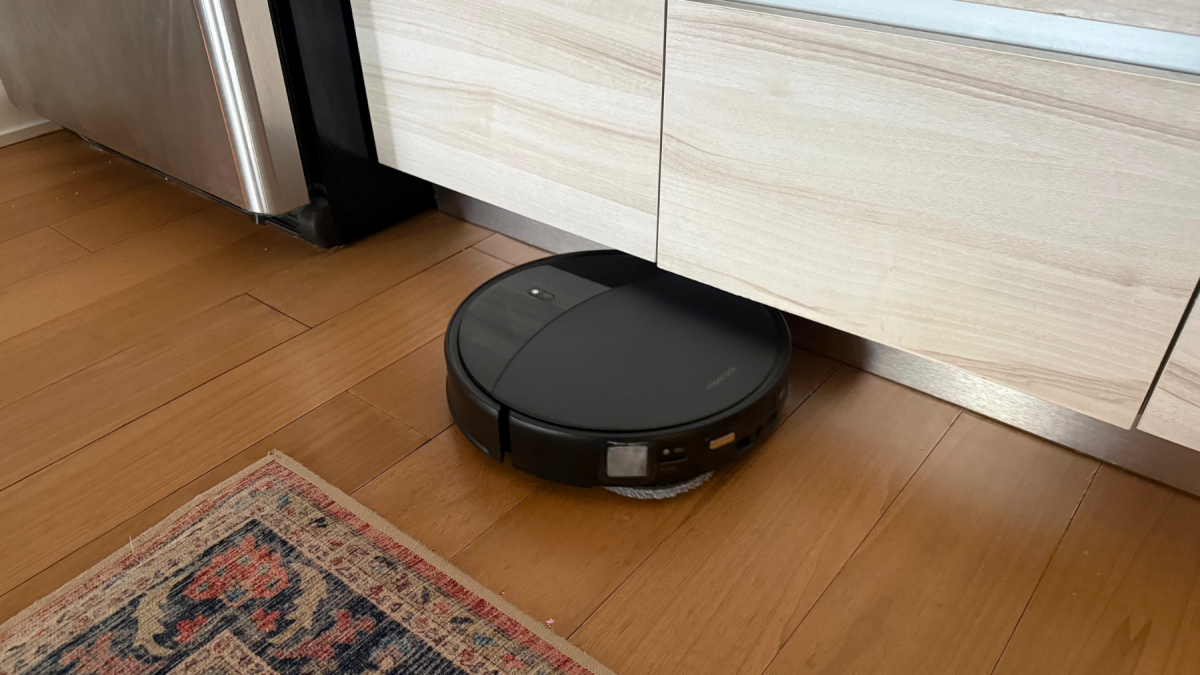
The Saros 20 easily cleans under cabinets.
Credit: Leah Stodart / Mashable
The Saros 20’s overall height would make it a great pick for homes with low-clearance furniture. It measures a little bit over three inches tall, which is well short enough to fully clean under my TV stand and bed frame. The same goes for cleaning under the overhangs of kitchen cabinets and appliances: If a robot vacuum can’t fit underneath to tackle those daily crumbs and splatters, it’s always a no from me. I don’t want to live a life where I can’t simply push crumbs off the counter and let a vacuum deal with it.
I knew the Saros 20 would ace that test, snatching up between 98 and 99 percent of sprinkles, shredded cheese, and some pinches of basil under the counter on the hardwood kitchen floor. It has also reliably kept up with its litter box area duties on hardwood and on tile in the bathroom, consistently picking up around 97 percent of kitty litter and litter dust.
I really have a newfound appreciation for ultra-slim robot vacuums after testing (and always having to rescue) the Dyson Spot+Scrub Ai. It’s nearly an inch taller than models like the Saros 20 and Dreame X60 Max Ultra Complete, which is enough to get itself wedged under my dishwasher or bottom kitchen drawer during almost every clean.

It feels so good to watch a robot vacuum fit under the Litter-Robot step.
Credit: Leah Stodart / Mashable

Sansa is shocked at the height difference between the Dyson Spot+Scrub Ai (left) and Roborock Saros 20 (right).
Credit: Leah Stodart / Mashable
Bonus test: Could the Roborock Saros 20 be used in a hair salon?
It also seemed appropriate to give the big, fancy 36,000 Pa suction a harder test than my usual robot vacuum obstacle course entails. After giving a friend a quick at-home buzz cut (no, I don’t know what I’m doing), I decided to see how the Saros 20 would handle the mess of hair clippings.

I’d typically reserve hair clippings cleanup for powerful stick vacuum testing.
Credit: Leah Stodart / Mashable

The Saros 20 dragged this clump to the rug edge, then couldn’t snatch it up.
Credit: Leah Stodart / Mashable
The Saros 20 picked up about 90 percent of the hair, but simply could not wrangle a few of the bigger clumps after four or five tries. The damp mopping cloths were integral during the second pass, wiping up the layer of fine, loose hairs that were initially missed in plain vacuum mode. (And that’s why hair salons can’t ditch the classic broom and dustpan.) The performance wasn’t perfect, but a vast majority of the mistakes were ones that could only be avoided by a human with a manual vacuum. To be fair, the Dreame X60 Max Ultra Complete missed those clumps, too.
Factors I’m keeping an eye on
I shouldn’t have had to send the Saros 20 back for a third pass as often as I did, especially for being the strongest robot vacuum one can buy right now. While it was typically able to throw together a quite wholesome clean after three tries, most people aren’t observing their vacuum like I am to know whether a third pass is needed. Shouldn’t a vacuum this expensive be better at conducting some sort of “before and after” check?
My kitchen floor felt greasy after testing the Saros 20’s effectiveness on condiments like ranch and sesame oil. Maybe I’ve been spoiled with roller mops that rinse themselves as they’re cleaning. But now, it feels unsanitary for non-roller mops to not go back to wash the mops every three minutes. The Dreame X60 Max Ultra Complete doesn’t have self-rinsing mopping pads, either, but at least it mops with hot water.
As the user, avoiding this isn’t rocket science: For larger spills that you don’t want dragged across the floor, you just need to enact a target zone cleaning rather than letting it tackle the whole room. Maybe I need to let the AI stain detection cook for another week or so. But right now, I don’t feel confident sending the Saros 20 over a spill larger than a dime-sized droplet.
That doesn’t mean I would recommend buying the Saros 10R over the Saros 20. (Even though the Saros 10R goes on sale for $999.99 now, I’d tell you to just spend that same amount on the Roborock Qrevo Curv 2 Flow.) Though I feel a little let down by the sequel to my favorite, I still have high hopes for the Saros 20 Sonic to be one of the best robot vacuums of 2026.
From YouTubers and TikTok stars to streamers and podcasters, Mashable talks to creators about how they built their platforms, the gear they swear by, and the trends they see coming next. Read more of our creator coverage, meet The Mashable 101 to discover the internet’s most exciting voices, and tell us about your favorite creators today.