
WTI crude Oil price dropped more than $4 per barrel after President Donald Trump signalled that US-Iran peace talks were progressing in an orderly fashion, and within hours, Bitcoin was approaching $82,000. Asia-Pacific equity markets opened higher across the board, with Japan’s Nikkei 225 gaining as much as 2.5% and South Korea’s KOSPI climbing roughly 3.7%.
The S&P 500 had already risen 1% overnight, confirming this was a broad global risk-on move, not a crypto-specific one.
The catalyst sits in a narrow stretch of water most people couldn’t find on a map. Understanding why that waterway, and the diplomatic talks surrounding it, moves Bitcoin is worth your time before the next headline hits.
Why Do Oil Price Affect Bitcoin? Here Is the Mechanism in Plain English
Think of global risk appetite like a thermostat in a shared office. When geopolitical tensions heat up, that thermostat gets turned way down, investors get cautious, pull money out of anything that feels risky, and park it in safe havens like US Treasury bonds or cash. When tensions ease, the thermostat rises, risk appetite returns, and money flows back into equities, commodities, and yes, crypto.
BREAKING: US oil prices extend losses and fall below $90/barrel for the first time since May 7th. pic.twitter.com/czw0T9dhWb
— The Kobeissi Letter (@KobeissiLetter) May 25, 2026
Oil is one of the fastest-moving thermostats in that system. The US-Iran geopolitical tension and oil price spike mechanism works like this: when naval disruptions threaten the Strait of Hormuz, the narrow chokepoint through which roughly 20% of the world’s oil trade flows, crude prices spike. Higher oil means higher inflation. Higher inflation means central banks keep interest rates elevated. Higher rates make risk assets like Bitcoin less attractive because safer alternatives suddenly pay decent returns.
That’s the chain: geopolitical tension → oil spike → inflation fear → tighter money → crypto sells off. Run it in reverse, diplomacy advances, oil drops, inflation pressure eases, money loosens, and risk assets rally together.
Right now, the chain is running in reverse. Naval disruptions in the Strait of Hormuz had pushed WTI above $100 per barrel earlier in 2025. Progress in Doha, building on earlier rounds in Islamabad with Pakistan and Qatar as mediators, just knocked more than $4 off that price in a single session. That’s not a small move, it’s the market pricing in a meaningfully lower probability of a global energy shock.
Asia-Pacific economies feel this more acutely than most. The majority of them are net oil importers, meaning elevated crude prices directly erode their trade balances and squeeze consumer spending. When oil falls, their economic outlook brightens faster than anywhere else, which is why Asian equity markets are often the first to react when energy diplomacy shifts.
DISCOVER: Best Meme Coin ICOs to Invest in 2026
Can Bitcoin Hold $76,000 as the Iran Framework Takes Shape?
BTC is sitting at $76,607 on the daily chart, and after pushing up to $84,000 earlier this month the price has since pulled back and is now sitting right at the $76,000 to $77,000 zone which was prior resistance from the 2024 consolidation range and is now being tested as support.
This is an important level to hold. The recovery from the February low at $61,000 up to $84,000 was a clean 37% move, and the current pullback is giving back a portion of that, but the structure of higher lows since February is still technically intact as long as price holds above the $72,000 to $73,000 range.
A hold and bounce from the current $76,000 to $77,000 zone keeps the recovery narrative alive and sets up another push at $84,000, which is the level that needs to flip convincingly before $88,000 and $92,000 come into view.
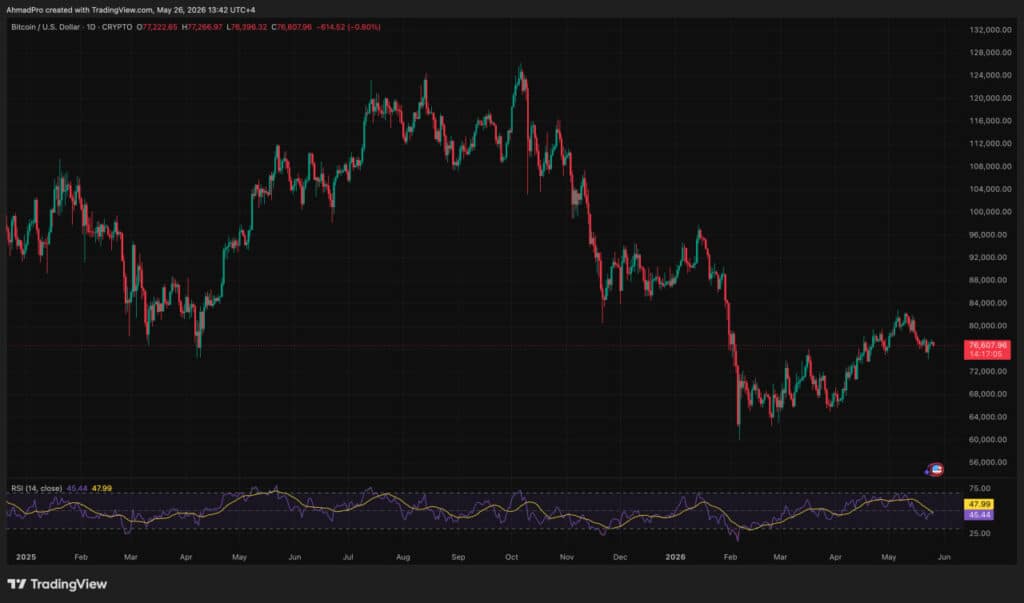
The bearish scenario is a failure to hold $76,000 sending price back toward $72,000, and below that $68,000 is the next serious support from the March and April base building range, a break there would signal the recovery has fully reversed.
The broader macro picture remains the same, BTC peaked at $126,000 in January, collapsed nearly 50%, and has been in a choppy recovery for 4 months without reclaiming any of the major levels lost during the crash.
Until $84,000 flips to support, this chart is still a recovery inside a larger downtrend and not yet a confirmed trend reversal.
DISCOVER: The Next 1000x Crypto Gem Before It Lists on Binance
Follow 99Bitcoins on X, YouTube, and Telegram for more crypto news and analysis.
The post Why Oil Price and Asia Stocks Matter to Crypto: US-Iran Talks Lift Markets appeared first on 99Bitcoins.